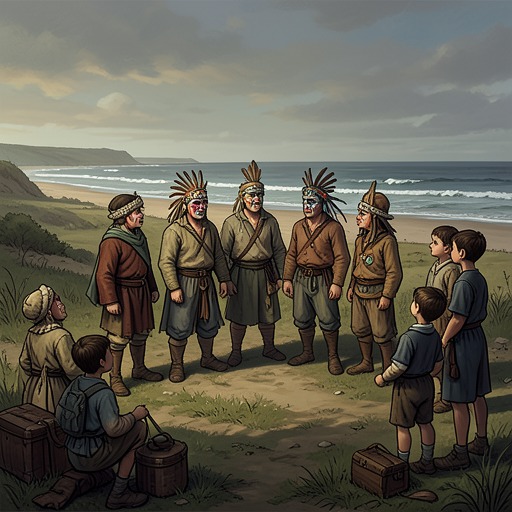
Jack's hunters
Lord of the FliesJack's hunters begin as the choirboys who arrive in disciplined lines beneath black cloaks and square caps, but their organization changes with the island's political order. Appointed by Ralph to lead them, Jack Merridew turns the choir into a hunting group and gives it a new purpose; after he breaks from Ralph, it becomes the core of a rival tribe whose authority rests increasingly on spectacle, obedience, and violence.
Formation and Early Structure
The group first appears as The choir and hunters in conspicuous uniform: black cloaks marked with a silver cross, square caps with badges, and a formation of two parallel lines. Jack Merridew, distinguished by a golden badge, commands them. Their appearance and drill set them apart from the other boys, while their exhaustion and the fainting of Simon expose the strain beneath their display of order. Jack handles the disruption briskly, allowing the others to sit and leave Simon alone.
When the boys elect Ralph chief, Jack Merridew's claim to leadership is rejected by nearly everyone outside the choir. Ralph nevertheless gives him authority over the choir, and Jack chooses hunting as its role. The concession eases the immediate humiliation: Jack's blush subsides, and he and Ralph exchange a shy smile. The choir discards its cloaks, and the group begins to take on a practical identity as hunters rather than simply a uniformed school contingent.
Hunting and Shared Duties
At first, hunting is only one part of the group's responsibilities. On the expedition, Jack Merridew and the others see a pig but fail to kill it; the animal breaks free. At a later assembly, Ralph argues that the boys need hunters for meat, while also insisting that they must look after themselves in the absence of adults. Jack's hunting group is thus formed within a wider attempt to organize common work, not yet as a separate society.
Jack also accepts responsibility for The signal fire. He proposes dividing the choir into groups, with altos and trebles taking turns tending it, and says the hunters will keep watch for a ship and add green branches to produce more smoke. This arrangement links the group's identity to both food and rescue. Yet the first fire effort produces a towering blaze without useful smoke; when Piggy protests that his claim to speak with the conch is being ignored, Jack dismisses the rule on the mountain. Ralph insists that the meeting rule applies there too. The contrast is already visible: Jack can endorse rules when they organize his group, while contesting them when they limit his authority.
The competing demands soon sharpen. While Ralph and Simon work on shelters, Jack's attention remains fixed on hunting. He admits that he continued after the others stopped, driven by the thought that he might kill, though he has not yet done so. He promises another attempt and wants a barbed spear, while Ralph presses the need for shelter. The exchange makes the group's priorities consequential: its pursuit of meat pulls labor and leadership away from the shared work Ralph considers necessary for survival.
Secession and a Rival Tribe
As the conflict with Ralph intensifies, Jack uses the hunt to challenge Ralph's fitness to lead. He calls Ralph a coward and argues that Ralph is not a hunter, although both boys went toward the beast on the mountain and both ran. Jack asks the assembly to vote Ralph out, but no hands rise. He lays down the conch, leaves Ralph's group, and offers to take anyone who wants to hunt with him. The failed challenge becomes an open break: hunting no longer sits under Ralph's authority but provides the basis for Jack's separate allegiance.
Jack's returning group soon appears painted and carrying away half-burnt branches from the fire. Jack announces that his followers live by a flat rock along The beach, where they hunt, feast, and have fun; he invites the others to join, while reserving the right to decide who is admitted. The invitation is both a recruitment pitch and a display of control. Painted faces allow Jack to address the others without the self-consciousness that had marked his earlier humiliation, and two accompanying boys reinforce his command by repeating that the chief has spoken.
Command, Coercion, and Collapse
At Castle Rock, Jack's authority becomes more plainly coercive. When Ralph demands Piggy's spectacles and argues that the group needs a real signal fire, Jack orders Sam and Eric to be seized after they fail to return to the tribe. The painted boys take the twins' spears and knock them down; Jack points to their compliance as proof that the others do what he wants. The group's allegiance is no longer expressed only through hunting or feasting: it is enforced against those who remain with Ralph.
The confrontation ends in catastrophe when Roger releases the great rock. It strikes Piggy and shatters the conch, while Jack proclaims himself chief and hurls a spear at Ralph. The attack is carried out by members of the tribe, but Jack's immediate declaration makes the group's political meaning explicit: the old token of assembly and its authority have vanished, and force is asserted in their place. Afterward, Jack presses Sam and Eric to join, prodding Sam with a spear when he resists; Roger approaches the bound twins with a further, unnamed authority.
The hunters' pursuit of Ralph completes the transformation from an organized choir into an armed collective. They chase him through the forest as a great fire races toward The beach, forcing him into the open, where he encounters a naval officer and the waiting cutter. The fire that had once been meant to summon rescue now engulfs the island during the hunt. Jack's group therefore ends at the point where its methods bring the boys into view of rescue, while the disciplined, communal organization from which it began has been consumed by the pursuit of its own rival.